




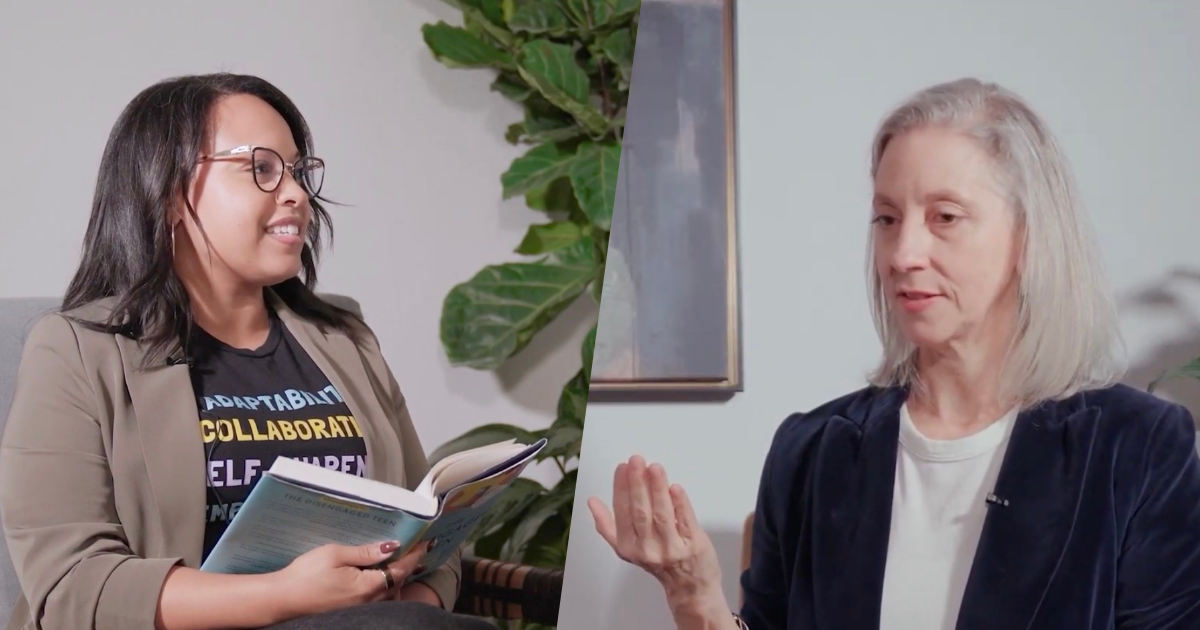
I have been eager to share this conversation ever since we wrapped filming. Dr. Rebecca Winthrop—senior fellow and director of the Center for Universal Education at the Brookings Institution—is one of those rare thinkers who can zoom out to a global view of education one moment and zoom in to a single student’s lived experience the next.
We covered a lot of ground: her research on the four modes of student engagement; the book she co-authored with Jenny Anderson, The Disengaged Teen; and her work as chair of a major global task force on AI and K-12 education. I walked away with pages of notes and a whole lot of conviction that the work Wayfinder does matters more than ever.
Who is Rebecca Winthrop?
Rebecca Winthrop leads Brookings’ Center for Universal Education, a research and policy hub that works in 70 countries with everyone who touches the education ecosystem: government leaders, civil society organizations, teacher unions, parent networks, youth groups, and funders. Their mission is to convert evidence into tools that are actually actionable for policymakers and practitioners in the field.
She also chairs the Deans for Impact Global Task Force on AI and Education, which recently released a major 200-page report focused specifically on generative AI and K-12 students. More on that in a moment.
Are We Headed in the Wrong Direction with AI in Education?
This part of our conversation keeps me up at night. After surveying evidence across 50 countries, Rebecca’s task force came to a sobering conclusion: we are currently headed in the wrong direction.
That doesn’t mean there are no benefits. Narrow uses of generative AI—helping teachers with creative lesson planning, leveling reading materials for neurodivergent students, and providing access to learning for kids who are out of school—show genuine promise. Those benefits are being overshadowed by the risks of wide, unfettered AI use, though: open dialogue with frontier model chatbots and AI companions that were not designed for kids or learning.
“The risks are starting to happen—undermining kids’ cognitive development, social emotional development, degrading trust in the teaching and learning relationship. We heard so many kids saying, ‘I can’t get started on my homework anymore without it.’”
—Dr. Rebecca Winthrop, Brookings Institution
That last piece hit me particularly hard because, at Wayfinder, everything we do is oriented around supporting students to be fully engaged—empowered, purposeful, seen, and heard. Cognitive dependence on AI tools before students have developed their own thinking habits undermines that foundation at the root. It’s not a hypothetical risk. It’s happening now.
The Disengaged Teen: Four Modes of Student Engagement
Rebecca and Jenny spent three years partnering with the nonprofit Transcend on large-scale national surveys of teachers and parents, and followed 100 students across the U.S. What they discovered reframes the entire conversation about engagement.
It’s not a binary of engaged or disengaged. Students show up and engage with their learning in four distinct modes, and understanding which mode a student is in changes everything about how you respond as an educator or a parent.
- Resistor Mode: Running in the opposite direction. Behavior that looks disruptive is often a message: “This doesn’t feel relevant. I don’t feel seen.”
- Passenger Mode: Coasting along. Present and compliant, but not really driving their own learning. They’re along for the ride.
- Achiever Mode: Trying to be perfect. High grades, high compliance—but learning to optimize for the grade, not for understanding or growth.
- Explorer Mode: In it for the learning, not just the grade at the end. Resilient, curious, and building skills that will matter in an age of AI.
Rebecca shared something that really struck me about achiever mode: the number one thing students in this mode told her team bothered them on a bad school day. “My teacher didn’t tell me exactly what to do to get an A.” Think about that. We are producing students who are technically high-performing but genuinely distressed when instructions aren’t perfectly linked to a prescribed outcome. That is not a skill set that translates to adult life, let alone a career.

Why Agency Is the Missing Axis
In The Disengaged Teen, Rebecca and Jenny plotted the four modes on a matrix—one axis is engagement, the other is agency. Agency is one of Wayfinder’s six Core Skills, so I asked Rebecca why she felt it was important enough to make it the second axis.
Her answer drew on 20 years of research by John Marshall Reeve and colleagues on what’s called agentic engagement. Most adults measure student engagement by behavior: Are they listening? Doing their homework? But students can be behaviorally engaged, emotionally engaged, even cognitively engaged—and still be entirely passive. Waiting to receive instructions. Waiting to be told what to do next.
Agentically engaged students are different. They actively shape the learning environment around them. They ask to write a paper on a topic they care about, request time to study with a friend, or ask where to read more about a topic that sparked their curiosity. Crucially, there’s a cycle: when students engage agentically, teachers respond by giving them more autonomy and more interesting work, which makes students more excited and more engaged. The research also shows that agentically engaged students don’t sacrifice academic rigor. They get better grades, and they’re happier.
“Kids are going to have to be agentically engaged when they leave school to wayfind and navigate their way through this changing sea of technology.”
—Dr. Rebecca Winthrop, Brookings Institution
Kia’s Question: Purpose as a Non-Negotiable
One of the things I love most about The Disengaged Teen is that it is grounded in students’ actual voices. Rebecca and Jenny asked young people real questions, such as, what was your day like, who are you, what do you want to do in the world, how does school fit into that? A student named Kia responded with a memorable depiction of what students are really asking for:
“We ask honest questions. Who are we? What is our purpose? And instead of answers, we’re given an equation. We want the chance to discover our passion, to find ourselves.”
—Kia, student quoted in The Disengaged Teen
Purpose undergirds everything we do at Wayfinder. We want students to feel like the pathway they’re pursuing is meaningful, not just productive. Kia’s words are a reminder that students are not waiting passively to be told what matters. They are already asking the big questions. Our job is to create the conditions where those questions can actually be explored.
Four Levers for Creating Explorer-Mode Conditions
One of the things I appreciate most about Rebecca’s work is that she doesn’t just name the problem, but also provides a practical toolkit. When I asked how school leaders and educators can begin to create conditions for explorer mode (especially in heavily tested subjects), she outlined four concrete levers:
- Family-School Alignment: Parents and teachers have to be on the same page about what explorer mode looks like and why it matters. Kids can get into explorer mode outside of school, but adults need a shared vocabulary and shared evidence to make that happen consistently.
- Autonomy-Supportive Teaching Practices: Classrooms can be shifted in small but powerful ways. Pause at the start of a lesson and ask what students are curious about. Offer two or three choices on homework. Use exit tickets to collect feedback and—critically—respond to it. When students see that their input actually changes something, the dynamic shifts.
- School Policy Changes: Rebecca is passionate about one specific policy: GPA requirements for extracurriculars. Students in resistor mode, the ones who tend to slip academically, are the ones who need extracurriculars most. Removing them from the spaces where they feel identified and capable makes everything worse. Interest in one area spills over into others.
- Whole-System Transformation: The long game is all about reorienting school systems so that students acquire knowledge and apply it—collaboratively, and to real problems in real communities. This is where explorer mode becomes the center of the experience, not a bonus when there’s time left over.
What I love about this framework is that levers one, two, and three are accessible right now. You don’t have to wait for system-level transformation to give a student two homework options or to open a class with two minutes of genuine curiosity. Those moments add up, and Rebecca’s research makes clear that they matter.
Practice Before the Stakes Are High
Near the end of our conversation, we discussed something I constantly consider when working with school districts: the importance of low-risk practice spaces. Rebecca mentioned that teens in the US are subject to twice as many rules as incarcerated people, from when they can stand up to when they can use the bathroom. If we want young people to be constructive citizens who can form good relationships, find meaningful work, and navigate an increasingly complex world, we have to give them space to practice doing that.
Wayfinder is designed to provide just this kind of practice. When I talk to districts about our curriculum, I describe it as a low-risk opportunity to practice essential skills before applying them in higher-stakes academic settings. Do a few collaborative activities before the big group project. Build empathy skills before students need to deploy them under pressure. Practice the skill of asking for help or saying “I don’t understand this” before it’s tied to a grade. Then watch what happens to the group project. Watch what happens to classroom disruptions. Watch what happens when students feel genuinely capable.

My Takeaways
I could have talked with Rebecca for another two hours. What sticks with me most is that the conversation around student engagement has often been framed as a nice-to-have, something you make room for when the academic pressure eases up. Rebecca’s research says the opposite. When students are genuinely engaged, especially in explorer mode, they have better mental health, fewer disciplinary issues, better attendance, and stronger academic outcomes. Engagement and rigor are not in tension. They reinforce each other.
The work is urgent. Generative AI is accelerating the stakes, and students are already asking the right questions about it. They’re asking who they are, what they’re for, and what they get to have a say in. Our job is to build the conditions where those questions lead somewhere.
Watch the full interview above, and if you haven’t picked up The Disengaged Teen yet, do it. It’s one of the most practical, student-centered books I’ve read in a long time. Feel free to explore more content on AI in education here.

Last Updated: April 9, 2026
